Client
Purdy & Figg
Industry
Eco-Friendly Cleaning Products
Platform
Shopify Plus
Partner
Valar Ecom (CRO & Shopify Experts)

Purdy & Figg ships to the UK through a network of regional fulfillment partners and to the US through one dedicated partner, and each market has its own fraud, SKU, and carrier rules. Orders were sorted by hand, one slow partner API could back up the whole queue, and problems only showed up in logs or the database.
We built a standalone fulfillment service between Shopify and every logistics partner. Each stage runs on its own queue, rules are configured per region from one codebase, and a live dashboard shows the ops team the queue depth, job status, and failures.
Order routing now runs on business rules with no manual sorting, and a partner outage stays in its own queue instead of stalling every order. The ops team can see and fix issues themselves, and adding a new market is now a configuration task rather than a development sprint.
Markets automated
UK and US, from one codebase
Independent queue stages
Tagging, routing, submission, polling, and write-back
Manual routing decisions
Every order routed by business rules
Live ops dashboard
Queue depth, job status, and failures, no database access needed
Purdy & Figg ships across the UK and the US, where each market plays by its own rules. While the UK runs through a network of regional fulfillment partners, the US runs through one unified, dedicated partner. Fraud thresholds are also different in both markets. SKU eligibility and carrier selection are both different as well. Even the definition of a “shippable” order changes depending on where the customer lives.
For a while, the team held it together manually, but that approach has a ceiling, and Purdy & Figg hit it fast. A single slow API response from one partner could back up the entire order queue. There was no safe way to add a new region, partner, or business rule without risking the whole system. And when something goes wrong, even something small, the only way to find out was to dig through logs or the database.
Purdy & Figg needed a system built to route orders intelligently, enforce increasingly specific rules, recover on its own when a provider stumbled, and expand into new markets without forking the codebase every time.
For this, we built a standalone fulfillment orchestration service, sitting between Shopify and every downstream logistics partner, that runs automatically without manual intervention.
It registers every order the moment it lands in Shopify, decides where that order should go, translates it into each partner’s native format, tracks it through to delivery, and writes the status back to Shopify.
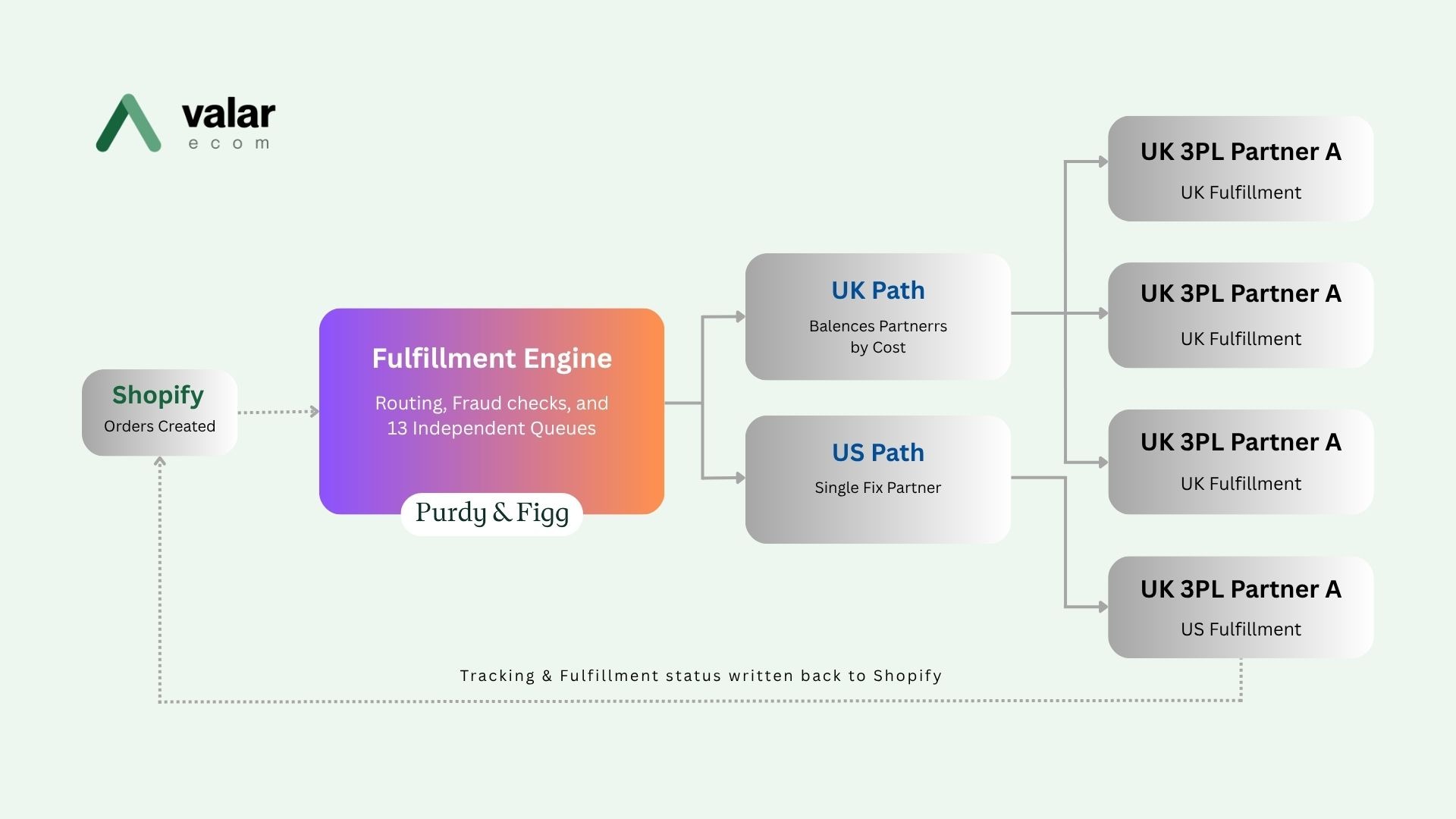
Instead of processing each order as one long synchronous chain, we split fulfillment into independent stages: tagging, routing, partner submission, status polling, and write-back, each running on its own queue.
If one provider slows down or goes offline, only its queue gets affected. Everything else keeps moving, and failed jobs retry automatically instead of quietly disappearing.
Rather than maintaining a separate repo for each market, we built a region-based profile configuration layer that turns providers and rules on or off per deployment.
The UK runs a broader multi-partner setup, whereas the US runs a single fixed partner. That’s the same codebase, but independent deployments. When Purdy & Figg is ready for a new region, it becomes a configuration task rather than a full revamp.
Fraud checks, SKU eligibility, and routing rules were all kept strictly separate from the provider-specific integration code. So, updating one partner’s API requirement never risks the rules that decide whether an order should ship in the first place.
We built in the judgment calls the ops team used to make manually, like order-type rules for fraud and validation checks, and a cost-optimization layer that automatically balances order volume across partners to keep shipping costs in check.
We added a live operations dashboard so non-engineers can see queue depth, job status, and failures without touching a database or a log file, alongside health-check endpoints for uptime monitoring and zero-downtime deploys.
Every log line carries a correlation ID, so tracking one customer’s order from webhook to warehouse takes seconds, not a support escalation.
30 minutes, your store, clear next steps.
| Before | After |
|---|---|
| Orders are manually sorted by provider and region. | Routing is fully automated by business rules. No manual assessments are required. |
| One provider’s outage risked stalling every order. | Outages are now isolated to their own queue and are protected end-to-end. |
| Status is only visible through logs or the database. | Self-serve visibility is now active for ops via a live dashboard. |
| Fraud and SKU assessments handled ad hoc. | Automated checks are now enforced on every order, every single time. |
| Adding a new market meant forking the codebase. | New-market expansion is now all about changing the configuration. |
Regional expansion is now something Purdy & Figg can plan on their roadmap, rather than something that requires a development sprint. A struggling provider no longer threatens order intake across the whole business. And the operations team can see, diagnose, and resolve issues themselves.
The region-profile pattern that powers the UK/US split was built with future markets and scalability in mind. This is where provider integrations, business rules, and routing logic are cleanly separated so we can add a new fulfillment partner or activate a new region just through configuration and testing.
Scaling into a new market shouldn’t mean rebuilding your fulfillment stack from scratch. If your DTC brand is hitting the same wall Purdy & Figg did, let’s talk about what a system like this could look like for your business.
Book a free 30-minute session with our Shopify and CRO specialists. Bring your questions, and we'll bring the plan.
Choose a slot that suits you and tell us a little about your store.
A focused 30-minute video call on your goals, your funnel and what's in the way.
Clear, prioritised next steps, yours to keep whether or not we work together.
Book a 30-minute session with the Valar Ecom team and leave with a clear plan to grow.
